

Nobody wants to hand the IRS a bigger check than they have to. Yet most owners think about taxes only after they’ve agreed to sell, when most of the good options have already closed. Let’s look at some of the most effective strategies for Sellers and Buyers this month.
Disclaimer: We are not CPAs, attorneys, or financial advisors, and nothing here is tax or legal advice. Bring these ideas to your advisors. That’s exactly what they’re for.
For Sellers
Six strategies worth knowing about before you sell. Use the resources we’ve linked and your advisors to go deeper into each.
Plan early (3 to 5 years out)
Ask any financial planner the single best move to cut taxes on a sale and the answer is almost always the same: start early. The strategies below only work if you set them up well before closing.
Tax loss harvesting
The idea here is to have a carefully managed investment (think stock, bond, or mutual fund). When a specific investment goes down in value, you sell it, taking a loss on paper, but to avoid market exposure, you buy its “twin” (think something like Ford and GM, the idea being stocks that typically move up and down together because they share common market factors). This strategy allows for an accumulation of “capital losses” on paper. These losses can be saved up over the years and can eventually be used to offset the capital gains incurred from a business sale.
Negotiate goodwill vs. assets
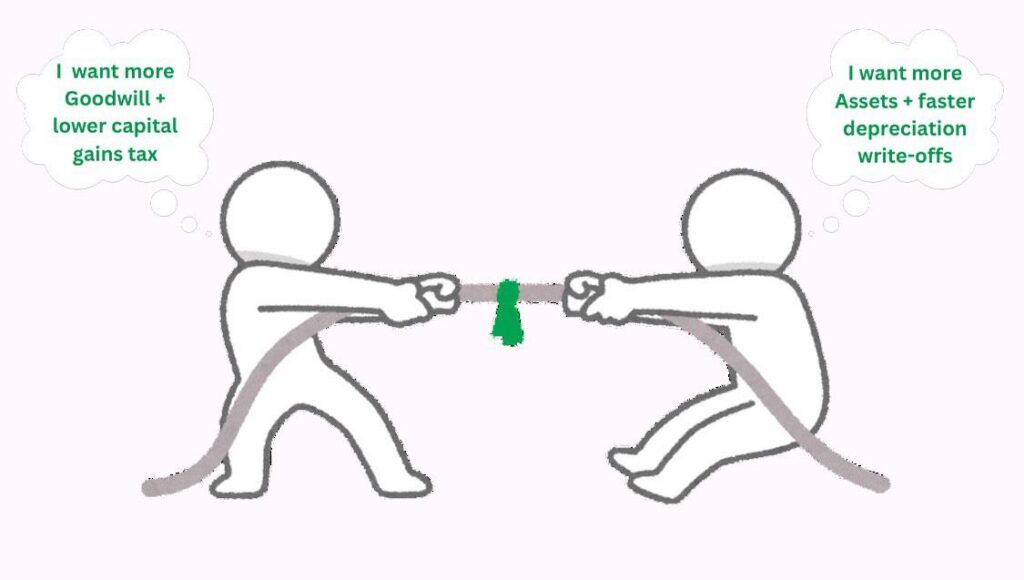
In an asset sale, Form 8594 splits the price between hard assets and goodwill. Goodwill is usually taxed at lower capital gains rates, so a higher goodwill allocation can save you a meaningful amount. It’s negotiable, so maximizing the Goodwill allocation can save a seller a significant tax burden.
1031 exchange
If real estate is part of your deal, a 1031 lets you roll the proceeds into a like-kind property and defer the capital gains, sometimes passing it to your heirs later tax-free. This can even be done with 1031 “funds” that work like mutual funds but with real estate.
Opportunity Zones
An Opportunity Zone investment is a federal tax incentive program allowing investors to defer and potentially reduce taxes on recognized capital gains by reinvesting them into Qualified Opportunity Funds (QOFs). These are real estate investments in distressed communities (“opportunity zones” or “OZ’s”) to stimulate economic growth, offering investors the potential of a permanent exclusion of capital gains taxes on profits from the sale of real estate if the property is held for at least 10 years. The other advantage of OZ’s is that you can receive rental income from the property during the course of your ownership.
ESOPs (for larger businesses)
With 10+ employees and EBITDA above roughly $2 to $3M, an ESOP can open the door to a 1042 exchange. We’ll cover this in a future issue.
Thinking about a sale in the next few years?
The earlier we talk, the more options you keep.
For Buyers
Buying a business usually isn’t a taxable event at closing, but a few moves matter.
Flip the goodwill logic
The seller wants high goodwill. You, as the buyer, want high assets. A bigger asset allocation lets you depreciate faster and lower taxable income in the first few years. Goodwill only amortizes over 15 years. So, while both elements can eventually allow a buyer to reduce their tax burden by the purchase price, the time value of money definitely favors doing so through a heavy asset allocation on Form 8594.
Here’s the key insight: for you, the tax effect is about timing, not total. A savvy buyer can offer the seller a friendlier allocation in exchange for a lower purchase price.
Funding with a ROBS plan
ROBS (Rollovers as Business Start-ups) lets you use existing retirement funds (like a 401(k) or IRA) to buy a business with no early withdrawal penalty. It takes some setup (establishing a C Corporation and a new 401(k) plan, which then buys stock in the new company), but it can mean more favorable tax positioning, no loan fees, no interest, and far more buying power.
The bottom line
These are only a handful of the strategies out there. We didn’t even touch trusts and the heavier legal vehicles. Two takeaways carry the whole newsletter: plan early, and talk to your CPA, financial planner, and attorney about your long-term goals.
We’re not your CPA or financial advisor. But a skilled broker works alongside that team to manage and minimize the tax drag on your transition.
With over three decades of experience buying and selling businesses, and as the most accredited brokerage in Colorado, we know how to build an exit strategy you can trust.
Businesses we’re representing right now

Chaffee County, CO
Asking Price: $850,000 (includes $250,000 of inventory)
Cash Flow (SDE): $407,905
Gross Revenue: $2,280,572

Colorado
Asking Price: $295,000
Cash Flow (SDE): $129,081
Gross Revenue: $495,206